4.18.2008

THE FORBIDDEN KINGDOM.

It’s the event we’ve all been waiting for… and it was freakin awesome! The whole movie is kinda like The Neverending Story meets The Karate Kid. When Jason (Michael Angarano), a Kung Fu-obsessed teenager, gets into trouble with a street gang, he ends up in the possession of an ancient staff that transports him back to ancient China. After meeting drunken traveler Lu Yan (Jackie Chan), Jason discovers that he’s quite possibly a prophesized traveler meant to bring this powerful staff back to its rightful owner, The Monkey King (Jet Li), so that the Monkey King can defeat the Jade Warlord (Collin Chou) and free the land of tyranny. Along the way, they also meet a young musician out for revenge, Sparrow (Yifei Liu), and a traveling monk (also Jet Li), on a journey to help reunite the staff with The Monkey King.

The beginning (after the Monkey King sequence) is really the only downfall to the movie. It’s cliché, questionably acted, and insanely fast-paced, as if they really didn’t care about the setup at all (which I’m sure they didn’t). The beginning stuff in ancient China is cool, but a bit slow. The movie really starts to pick up with the tea house fight scene. This part also introduces us to Sparrow, who… for some strange and unexplained reason… likes to speak in the third person. It’s a bit confusing at first, but you get used to it. Though she’s really hot, so that makes up for it, too.

The fights scenes are amazingly choreographed, and you really can’t tell Jet Li or Jackie Chan’s age in any of it. They move fast, and they move awesomely. And there’s very little Wire-Fu, as the trailers seem to indicate the contrary. It is there, don’t get me wrong, but it’s minimal. Most of it is straight-up Kung Fu action. And the action scenes are all pretty long, which is great… especially the Chan/Li fight, which goes on for about 5-10 minutes at least. The price of admission is worth it simply for that fight, but all the other ones are just as amazing.

The biggest problem people have been having (prior to seeing it) is with the ‘white kid’. Let me tell you, it’s actually not bad. His story arch works, and it isn’t overly cheesy or anything. And his fighting is actually pretty well done. He doesn’t become a super master or anything, so it isn’t all cliché like that. He still gets his ass kicked after learning to fight. The fighting lessons just help him to stand more of a chance than he would have had otherwise.

As for Chan and Li, you could tell they really had a lot of fun making this movie, especially Li with his Monkey King character. It’s over-the-top and goofy, but it works and is just as cool as everything else. The ending of the movie isn’t nearly as cliché or predictable as you would think, as it is only really half of a typical Hollywood ending. The visuals were great, and the music was stunningly amazing. I found that I really enjoyed the music of this movie.

For a kid’s movie, it was really well done, and I loved the action and everything else about the movie. I’d go as far as saying that it’s one of my favorites for the year (thus far). They could have worked on Jason's intro a bit more, but it's really overshadowed by the rest of the movie. And I’m totally gonna go see it again.

Photobucket
A Keanu 'Whoa'

4.15.2008

THE RUINS.

I saw and reviewed this movie over the weekend, but didn't put it up due to the Week of Recent East Asian Cinema event going on. The only reason I saw it in theater was because I made a deal with a fellow LAMB, Shea, that I would see and review this, and he would see a certain movie that I keep going on about. Well, it's totally unfair, because he's gonna get to see a totally awesome movie, and I, well... you'll see...

----------

This movie is like mixing Cabin Fever with The Descent… except with monster vines instead of Gollums. The movie is about four 20-somethings vacationing in Mexico: Jeff (Jonathan Tucker), Amy (Jenna Malone), Eric (Shawn Ashmore), and Stacy (Laura Ramsey). When a German guy named Mathias (Joe Anderson) mentions that he was gonna go find his brother who went off with some archaeologist woman to an old Mayan temple in the middle of nowhere and haven’t come back yet. So of course they all want to go. But when they get there, these ‘guardians’ of the ruins show up and won’t let them leave… and then the plants of the ruins are alive and start attacking them and such.

So yeah, it was a pretty cliché movie, from the story to the characters. There actually really is no plot except that they get stuck on this big hill/ruins and can’t leave and start dying one by one. I mean, even leading up to the point of the ruins is silly. “Let’s go off the beaten path to the ruins where nobody has returned from… and even though the path is covered up which obviously means ‘do not enter’, we should keep on going anyway. And then let’s give our only working phone to one of the men that is trying to kill us.” The writing can be written off by one line in the movie: “Somebody will come! Four Americans on Vacation [in Mexico] don’t just disappear!” Uh, yeah… what news have you been watching, buddy? Everything basically happens like you figure it would.

As for the characters, it’s cliché city here, as well. In fact, the only character I really cared any amount about was Jonathan Tucker’s Jeff, who was pretty decently acted and the obvious main character. The others… I forgot their names almost immediately and renamed them with the clichés they embodied: Eric became ‘complaining friend with stupid idea that will get them killed’ and Stacy became ‘hot girl who cries and panics all the time’. Seriously, when the ending came about, the immediate thought in my mind (and this never happens) was “run, final girl, run! There you go, falling down and looking back! Just run!” Even the very end was a cliché horror movie technique. We seriously didn’t know much of anything about any of the characters, except for Jeff, who is going to med school (luckily for them). So there’s a really funny line toward the end of the movie… “You don’t know anything about us!” I was like “Yeah, no shit!”

But there are some positives. All the stuff at the ruins with Mathias was cool (it was the suspenseful/gory parts), as well as the stuff soon after with Stacy. There’s also some eye candy in the beginning when the main chars are all doing the horror movie ritual of partying. The gore stuff toward the end, though, was probably the only reason I bumped up my scoring to where I did. It didn’t fix the movie by any means, but it at least made it more interesting and/or worthwhile instead of watching a bunch of random people crying and complaining on top of a hill for 90 minutes.

The plant/vine monster… thing… whatever it was… was alright. It actually didn’t attack very often. It attacked them like… twice. But the first time put it inside the body, so that’s really all it needed. Every other time, it just pulled away the dead or bloody stuff. And the echo flowers were a neat concept, though incredibly weird. They helped to lure them, as well as increase paranoia, so they worked at that. Otherwise, they were just odd.

So yeah, I would probably recommend waiting for it to be on Showtime or HBO or Starz… whatever channel you watch your movies on. At least wait for the rental if you must. It’s not God-awful, but it could have been so much better and a whole lot less cliché. It just needed some substance, with both the plot and the characters. But if you’re a blood/gore kinda person, the last 1/3 of the movie, at least, might satisfy to some degree.

Photobucket
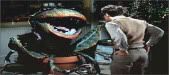
Feed Me, Seymour!

(P.S. It's ironic that my rating for this movie is a plant monster, huh?)

Recent East Asian Cinema #7: Nobody Knows.

Welcome to the seventh (and final) of seven posts that will detail East Asian cinema, giving genre history leading up to a recent movie which will be reviewed! I hope you enjoy the series. For more information or previous entries, check the posts below this one.

-----------

Genre:
Drama.

History: Drama, next to comedy, goes so far back that it would be incredibly hard to detail the history of the genre in this space. So, instead, I will just give a brief history of the genre for Japanese culture. The 1950s really was the big time for the Japanese drama, because it was the debut decade for Akira Kurosawa, who made films like Rashomon, Seven Samurai, Yojimbo, and Ran. Some of his films, such as Ran and Throne of Blood, were based on Shakespearian plays (King Lear and Macbeth, respectively). His films inspired many people, from Sergio Leone to George Lucas.

Three years after the 1985 release of Ran, a set of (completely unrelated) events would occur in Japan widely known as the “Affair of the Four Abandoned Children of Sugamo.” These events would later inspire a 2004 film entitled Nobody Knows, based on the same events, but toned down quite a bit. The movie was Japan’s entry for Best Foreign Film for the Academy Awards, and it won Best Actor Award at the 2004 Cannes Film Festival for fourteen-year-old Yûya Yagira, as well as two other awards (including Best Film) at two other film festivals. And it is the final film I will be discussing for this week of Recent East Asian Cinema.


Nobody Knows (2004).

Country of Origin: Japan.

Original Title: Dare mo shiranai.

Director: Hirokazu Koreeda.

Nobody Knows is about a single mother, Keiko (You), who leaves her four children—Akira (Yûya Yagira), 12 years old and the oldest of the group; Kyoko (Ayu Kitaura); Shigeru (Hiei Kimura); and Yuki (Momoko Shimizu)—alone in an apartment for over a year. She sneaks the younger three in via luggage, and the landlord only knows about Akira and Keiko. All of the children are also born from a different father each, and none of them are registered as ever being born, so none of them goes to school. Keiko has a job (and boyfriend) out of town, and she begins leaving for longer and longer periods of time before she eventually just stops coming home. So now the kids must fend for themselves as eventually they run out of money and therefore food, electricity, and water.

This movie is pretty hardcore, especially since it’s a true story. And what’s worse, I read up on the real story, and it really is a lot worse than it was portrayed in the movie (which is hard to believe). The movie is almost 2 and a half hours long, and feels it. You’re dragged along (especially in the first hour) with these poor children and how they slowly start running out of money and everything else. Akira has to start becoming friends with some store owners in order to get some free food, they have to get water and bathe at the water spout in the park, and just live by the sunlight.

It’s a really tough movie to watch, as you know everything is just going to get worse and worse until it ends in just a depressing manner. But in doing so, it’s a really powerful movie, showing everything these kids had to do to survive, as well as their changing moods and all the decisions they make. You know you were in for a rough time from the very beginning, when you see the mother and oldest son sneaking the other kids in via the luggage (like, they were hiding inside it).

The only negatives would be that the movie is really slow, and the ending (as well as the overall movie in general) is really depressing. And then it has an open ending with no real resolution (which is why I had to go research what really happened). I bet if I watched it again, I’d grow to appreciate the movie even more, and I already really appreciate what it did do in the first place. But I just remember staring at the timer on my DVD player wondering if the movie was ever going to end… though I didn’t want to turn it off, because I was engaged enough to want to know what happened to the kids. It was a bizarre feeling. I think this is one of those movies that everybody should see at least once, but it would be hard to give it a second viewing just because of the subject matter. So yeah… time to rate it.

Photobucket
I Am McLovin!

4.14.2008

Recent East Asian Cinema #6: Shaolin Soccer.

Welcome to the sixth of seven posts that will detail East Asian cinema, giving genre history leading up to a recent movie which will be reviewed! I hope you enjoy the series. For more information or previous entries, check the posts below this one.

--------------

Genre:
Hong Kong Action Cinema/Comedy.

History: In yesterday’s history lesson, I discussed the early history of Hong Kong Action Cinema. By the time I got to the 1990s, I mentioned that these movies went into a slump, and two types of movies brought them out of it. The first was the rebirth of the wuxia film, AKA the type of film that Jet Li would make. The other type that helped get Hong Kong out of a slump took the other route, with the types of movies Jackie Chan would make.

Jackie Chan really brought into the mainstream the kung fu comedy with his slapstick humor and realistic stunts. However, the man to help bring Hong Kong out of its slump was not Jackie Chan, but a man named Stephen Chow. Stephen Chow is a comedian, but a lot of his jokes dealt with Chinese culture, meaning that the Western World wouldn’t have understood a lot of his material. Thus, his earlier films went mostly unrecognized internationally. However, he then created a movie by the name of Shaolin Soccer, which was not only an international hit, but became the best selling movie in China at the time. That title would only be succeeded by Stephen Chow’s next movie, Kung Fu Hustle. So now we’re going to focus on the kung fu comedy with Shaolin Soccer.


Shaolin Soccer (2001).

Country of Origin: China/Hong Kong.

Original Title: Siu lam juk kau.

Director: Stephen Chow.

The movie is about a former Shaolin monk, Sing (Stephen Chow), now basically living off the street, who wants to bring Shaolin Kung Fu to the masses, as he believes it will make all lives easier. But when former soccer star Fung (Ng Man Tat) is fired by his evil brother, Hung (Patrick Tse Yin), he stumbles upon down-and-out Sing on the street and realizes that he has a Mighty Steel Leg that could work wonders in soccer. So Sing tries to get together his former monk brothers, all with special abilities of their own, to put together a Shaolin soccer team. The only thing in their way is Hung’s Team Evil, who they must beat in order to win the competition.

This movie is crazy, wacky, and random. There’s even a random dance number (which I’ve included in my Top 10 Random Dance Scenes) that’s bizarre, but hilarious. The movie is funny and over-the-top, and there really isn’t much to say about it. It’s basically a parody on both wuxia and sports comedy.

The special effects are pretty good, especially within the final soccer match. The story is fun, the actors/actresses have good comedic timing, and the movie is all around plain good fun. That’s the only real way to describe it. There’s really not much else to say about it, really, so I’ll leave it at this rather short review.

Photobucket
A Keanu 'Whoa'

4.13.2008

Recent East Asian Cinema #5: Hero.

Welcome to the fifth of seven posts that will detail East Asian cinema, giving genre history leading up to a recent movie which will be reviewed! I hope you enjoy the series. For more information or previous entries, check the posts below this one.

----------------

Genre: Hong Kong Action Cinema/Wuxia.

History: Hong Kong Action Cinema was a brand of movie that took the Hollywood view of the action movie and mixed it with Chinese tradition and mysticism. The first brand of this type of movie was called wuxia, starting back in the 1920s, which typically emphasized the mysticism and fantasy aspects. They used wires and trampoline acrobatics, along with camera techniques, to show quick moves and flying styles. Most of these early movies were based on literature of the same style. Some of the first big stars of the wuxia subgenre were Cheng Pei-Pei and Jimmy Wang-Yu, as well as Connie Chan Po-chu, a woman famed for playing male roles.

However, in the 1930s, the wuxia subgenre drifted out of cinema due to political reasons and were replaced with more realistic hand-to-hand kung fu combat. After World War II, due to severe cultural changes, wuxia began to come back into style with grittier violence. In the 1970s, Bruce Lee made famous Hong Kong Action Cinema, only to be succeeded by Jackie Chan and Jet Li in the 1980s.

Though while Chan and Li might have brought some new appeal with the martial arts films, the mid-1990s put Hong Kong films into a slump. Two types of movies helped bring them out of the slump. One type will be talked about now, and the other tomorrow. The first type is the rebirth of the wuxia film with the international hit Crouching Tiger, Hidden Dragon in 2000. Soon after, even though he had seemingly left the martial arts epic for more American films, Jet Li returned to his roots with yet another wuxia film, Hero, in 2002. Hero helped, along with the aforementioned film, to bring wuxia back into popularity. It was a hit in China, so much so that Quentin Tarantino (who has often been inspired by the martial arts/wuxia films himself) took notice and decided to finance it enough to bring it to American audiences in 2004. And it is the very film we’re going to look at today.


Hero (2002).

Country of Origin: China/Hong Kong.

Original Title: Ying xiong.

Director: Yimou Zhang.

The first couple times I saw this movie, I thought it was really good, but didn’t fully comprehend what it was doing (as in, respect it). After my most recent viewing, however, I think I really get the film and like it that much more. Hero is about Nameless (Jet Li), a low-class man who defeated three of the most powerful assassins in the country—Sky (Donnie Yen), Broken Sword (Tony Leung Chiu Wai), and Flying Snow (Maggie Cheung)—who had been trying to murder the King of Qin (Daoming Chen). The movie chronicles (as imdb states) a series of Rashomon-like flashbacks to try and figure out how Nameless truly came about defeating these assassins. The movie also stars Zhang Ziyi as Moon, a servant to Broken Sword and Flying Snow.

First, I have to mention the obvious: this film was beautiful in numerous ways—its cinematography, its color-coding, its choreography. Every scene had a special color-coding (usually specific to the flashback sequence or location), and that was only helped by the amazing cinematography. The choreographed fights were amazing, as well. One big issue I’ve always had with fights scenes that are usually one-against-many is that the many always stand around and do nothing, giving the one person an easy time in the fight. There are two movies in recent memory that actually have everybody attacking at once: the first is the previously reviewed Oldboy (in the hallway fight) and this one. When Sky takes on all 7 guards toward the beginning, he’s really taking them all on at once, and it’s amazing to watch.

The story is simple, yet complex. There are 3 versions of the story told via flashbacks, and you don’t get the full truth until the very end. I think the plot twist would have been stronger had it not been revealed halfway into the movie (which I think had been my original issue with the movie), but it’s still a strong message and a cool plan that was set up.

There was one specific moment, though, that I’d like to bring attention to, because it was just weird/funny, and I’m not sure if it was meant to be. Halfway through the first flashback’s fight between Nameless and Sky, an old man who had been playing music starts to leave. They don’t even show the two stop fighting, but randomly, Jet Li is facing the man and asks him if he would please play some more music. Then the camera shows the blank faces of all three men one by one as the man gets out his instrument to continue playing. It was just a really bizarre scene, but it was followed by a cool fight sequence, so it didn’t really bother me.

There’s really not much else to say about the film. Jet Li’s voice over, I think, could have been better, to a degree, but besides that and anything previously mentioned, the film was fine (though it could have used some Zhang Ziyi nudity. There was a sex scene, after all). But the movie was beautiful to watch, the story was great, and a few things actually reminded me of 300 with Leonidas, so that was cool. So yeah, that’s about it for this one.

Photobucket
A Keanu 'Whoa'

4.11.2008

Recent East Asian Cinema #4: Oldboy.

Welcome to the fourth of seven posts that will detail East Asian cinema, giving genre history leading up to a recent movie which will be reviewed! I hope you enjoy the series. For more information or previous entries, check the posts below this one.

----------------

Genre: Mystery/Thriller/Revenge Tale.

History: Because the genres of this movie are so vast, this section will, inevitably, be much shorter than the others (You know that makes sense!). Mysteries are basically those stories and/or movies in which something has occurred, and it is up to one or more characters (usually a detective of some sort) to figure it out. There is usually a plot twist at the end. The Thriller (sans Michael Jackson) is typically a fast-paced story focusing strongly on plot and action, moving forward at a quick yet suspenseful rate. The Revenge Tale is about as old as fiction itself, which usually involves either the protagonist or antagonist of the story doing something to exact vengeance on the other character.

These aren’t themes/genres that are specific to East Asia; however, when you mix the three together into one story that comes from the mind of an East Asian, you have the possibility of creating something amazing. And such was done in 2003 when South Korean director Chan-wook Park adapted to film a Manga by the name of Oldboy. It would become the second movie of his Revenge trilogy (the other two being Sympathy for Mr. Vengeance and Sympathy for Lady Vengeance), though, in my opinion, it would turn out to be the greatest of the three. It was in talks for a long time about being remade in America, but that's been put on hold for now. Let's hope it stays that way (seriously, there's no way this could be Americanized and still stay true). So let’s get to it.


Oldboy (2003).

Country of Origin: South Korea.

Original Title: Oldboy.

Director: Chan-wook Park.

Oldboy starts as a mysterious man with messy hair is holding another man over the edge of a building by his tie. He wants to tell this man his story, and, thus, we flash back 15 years. Oh Dae-su (Min-sik Choi), a normal Korean businessman, is kidnapped and kept imprisoned in a bedroom. He has nothing to keep him entertained in the room except for a television. Here he learns that his wife was murdered and that Oh Dae-su himself, who had gone missing, was to blame for it. He teaches himself to fight over the years of captivity, as well as keeps time by tattooing himself. Then, after 15 years, he's released with a new suit and a cell phone. After telling the poor man on the roof all of this, he moves on. He meets the young and beautiful sushi chef Mi-do (Hye-jeong Kang), and they quickly fall in love. Oh Dae-su is then told by mysterious Woo-jin (Ji-tae Yu) that he has 5 days to find out why he had been captured in the first place or Mi-do will be killed.

This movie, quite frankly, is phenomenal. It’s one of my favorite foreign films. The story and concept is awesome, and it’s executed well. There really isn’t a time where anything drags. You wonder at first how these two characters could have fallen in love so quickly, but everything is perfectly explained and not left to be questioned (with one big exception, which I’ll get to in a minute) by the end of the movie.

There are some great shots in the movie, such as the huge 5 minute or so hallway brawl that is one continuous shot (it took about 17 takes and 3 days to get it right). They really went all out in the movie. There’s a scene where Oh Dae-su has to eat a live octopus. Do they CGI it? Nope. They actually made the actor eat a real live octopus. That’s hardcore.

The ending of the movie is great, as the plot twist is literally one of the most twisted I’ve ever seen. It’s intricate and detailed. Woo-jin is really not a guy I’d want to cross (The plot twist is actually on my list of best movie twists from way back). However, the one thing I do somewhat dislike about the movie (though it’s growing on me) is the ‘epilogue’ of the movie. It’s weird when movies have epilogues, especially when you can tell it has that epilogue feel to it (not important to the plot, but tacked on to give some more closure). The snow setting with the hypnotist is bizarre and almost doesn’t seem as if it fits with the rest of the movie, but I can see why it’s there and why it needed to be done. However, even though it’s there, everything is left incredibly ambiguous, so you still don’t know if it was real or not. Nevertheless, I love the part at the very end, when the movie is closing. It was a perfect way to end it, and it wouldn’t have been able to end it that way had they stopped right before the epilogue. So, in that sense, I’m happy it was there. Still, the scene isn’t even 5 minutes long in this 2 hour movie, so it doesn’t ruin anything for me.

So yeah, cool action, great shots, amazing story and concept (albeit twisted), and really fun and pumped music that really fit the scenes. Everything was great all around. I’d recommend this movie to just about anybody that doesn’t mind subtitles (as long as they aren’t close-minded and easily turned-off by certain things). I’m sure you’ve already guessed this rating.

Photobucket
Royale With Cheese

Recent East Asian Cinema #3: Audition.

Welcome to the third of seven posts that will detail East Asian cinema, giving genre history leading up to a recent movie which will be reviewed! I hope you enjoy the series. For more information or previous entries, check the posts below this one.

-----------

Genre: J-Horror.

History: Horror films go way back, but we’ll be discussing a certain brand of horror here: movies of gore. To begin with this subgenre, we must begin with the two movies that inspired them all. In 1960, Alfred Hitchcock created one of the most iconic horror films with one of the most iconic murder scenes (even though the shower scene doesn’t really show the knife penetrating and has an insanely small amount of blood). However, in 1968, George A. Romero created Night of the Living Dead (inspired by the novella I Am Legend), the movie to really make the gore-movie popular. And it was only outdone by its sequel, Dawn of the Dead, ten years later.

It was a mix of these types of movies that went on to inspire the first true slasher movie, Black Christmas (1974), as well as the famous Friday the 13th (1980) and Nightmare on Elm Street (1984) movies. Also in 1974, we were introduced to the movie that really began the torturous splatter-gore subgenre with The Texas Chainsaw Massacre. Throughout the 70s and 80s, we were introduced to numerous slasher flicks and gore-fest flicks until the genre wore itself silly (much like the monster movie did).

Then, in 1996, the gore-loving slasher flicks would get a revival in the form of Wes Craven’s self-aware, homage-paying Scream. The revival of the genre was short-lived, however, as it soon began to wear itself thin again with countless additions to the genre, such as I Know What You Did Last Summer (1997), Urban Legend (1998), and the more original and better-liked Final Destination (2000). Because the subgenre was riding its last threads, it seemed as if everything had to be knocked up a few notches. The gore would become the center of the movie, and Eli Roth’s Hostel in 2005 would be responsible for garnering the term torture porn and coining it into mainstream cinema.

Meanwhile, while all of this was occurring in American cinema, something else entirely was happening with Japanese Horror (J-Horror). J-Horror was taking two different approaches: the supernatural/psychological and the gore-fest. Famed director Hideo Nakata would create movies (which would later be remade in America) such as Ringu (1998) and Dark Water (2002). These were on the supernatural/psychological side of the spectrum. On the other side of the spectrum was famed and controversial director Takashi Miike, who made movies such as Ichi The Killer (2001), One Missed Call (2004), and Audition (1999). The latter of this list, which has its roots deeply set in everything previously mentioned (slasher/gore/psychological), is truly one of the scariest and most disturbing movies Japan has to offer… which is why it’s the movie I’m going to discuss now.


Audition (1999).

Country of Origin: Japan.

Original Title: Ōdishon.

Director: Takashi Miike.

Audition is about Shigeharu (Ryo Ishibashi), a man who lost his wife to an illness seven years prior. His son, Shigehiko (Tetsu Sawaki), as well as his movie producer friend, Yoshikawa (Jun Kunimura), talk him into getting back into the field and trying to find another wife. Yoshikawa talks him into holding a fake audition, where the women will think they’re auditioning for a movie role, but are really auditioning for the role as Shigeharu’s wife-to-be. During these auditions, Shigeharu meets Asami Yamazaki (Eihi Shiina), a young, shy woman who claims to have been a ballerina. Shigeharu thinks he’s finally found his perfect match, even against Yoshikawa’s warnings that Asami doesn’t seem right. Asami lives in an empty apartment with nothing but a telephone and a burlap sack (though Shigeharu doesn’t know this). They continue to date until Asami makes Shigeharu promise that he won’t love anybody else but her. However, things don’t start checking out right. Asami’s references are either fake or missing. Shigeharu has to figure out what’s going on with Asami before it’s too late (and we all know what happens next!).

The movie has an incredibly slow pacing, especially at the beginning. But it’s done like that on purpose. The movie wants you to get to like Asami as this cute, shy young woman before the ending hits like a bag of bricks. It’s the suspense that keeps you watching. What’s in that burlap sack? What happened to Asami’s music producer ex? Just when you think it’s dragging a bit too long, the movie throws you a curveball and makes you go ‘what the hell?’ (Specifically the scene where the burlap sack moves, and Asami’s just listening to the phone ring, staring down at her lap, and a small smile crosses her lips. It’s the creepiest scene in the whole movie. I even knew it was coming beforehand, and I still jumped and got creeped out).

But the movie all builds up to that insanely graphic 15-minute conclusion, which is really the only scene anybody remembers (or cares about). The only bad thing about that scene is that I remember being incredibly confused the first time I saw it. Halfway through, it cuts away to some other crazy things and makes you wonder if the whole thing was a dream… but then cuts back to it after what seems like ages. It was just an odd moment for me.

The movie is close to two hours long, but not much actually happens until the very end. I know the slow-rising pacing was done purposefully, but I think some of it could have been a bit better (primarily toward the beginning). The ending is hardcore, and it has even made famed directors John Landis and Rob Zombie admit they had trouble watching it (which they admitted on Bravo’s Top 100 Scariest Movie Moments, in which Audition came in at #11. It was where I first heard about the film, actually). Regardless of any negatives, the slower parts did allow for character development, which allowed you to actually care for some of these characters (making the ending even crazier). So I suppose I should rate it.

Photobucket
A Keanu 'Whoa'

4.10.2008

Recent East Asian Cinema #2: Spirited Away.

Welcome to the second of seven posts that will detail East Asian cinema, giving genre history leading up to a recent movie which will be reviewed! I hope you enjoy the series. For more information or previous entries, check the posts below this one.

-----------

Genre: Anime.

History: Anime is short for animation, and is primarily used to describe Japanese animation that usually stems from Manga (Japanese comic books). The term itself, in Japan is used for all animation; however, it is used, as stated, to describe Japanese animation for English speakers. Anime isn’t your typical animated family-type film. It can be, but that’s not what it’s stuck to. The genres of Anime are just as broad (and then some) as any other type of movie.

Believe it or not, Anime as we know it began because of Walt Disney. Japanese animators were impressed with the style of Snow White and the Seven Dwarves, so they decided to try and mimic the style. It was only meant, however, to be temporary for animators with little skill when production companies were in a pinch.

But when Manga became popular in the 1970s, they began to become adapted into an animated format in this Anime style. The “father of Anime,” and overall Japanese equivalent to Disney himself, is Osamu Tezuka, who was both a creator of Manga and Anime. He was responsible for such works as Astro Boy and Kimba the White Lion (which, ironically, later came into controversy with Disney's own The Lion King).

But Anime was still primarily a Japanese thing. It wasn’t until the 1988 anime film Akira (based on the Manga of the same name) that Anime began to become popular in the Western World. After Akira, which brought a second wave of Anime fans all around, the style began to grow and expand even more, having any movie type from giant robot action/dramas to slapstick comedy to gay porn. There wasn’t a subject that anime wouldn’t tackle.

Currently, the most acclaimed director of Anime is Hayao Miyazaki, co-founder of Studio Ghibli. He became well-known in the Western World with his film Princess Mononoke in 1997, which was, at that time, the highest grossing film of all time in Japan. He later created Spirited Away, the film we will be focusing on today, which was the first Anime film to ever win an Academy Award.


Spirited Away (2001).

Country of Origin: Japan.

Original Title: Sen to Chihiro no kamikakushi.

Director: Hayao Miyazaki (and Kirk Wise for English version).

Spirited Away is a weird (as most Anime can be considered… cultural thing), yet endearing movie. Chihiro is a rather whiny and stubborn young girl moving to a new town with her parents. When her dad tries to make a shortcut to their new house, they get lost and end up in front of an old, abandoned theme park (or so it seems). Even with Chihiro’s refusals to go in, they end up wandering around until they find some food, which they chow down on (except for Chihiro, who denies). Chihiro wanders off and discovers and old bathhouse. But when it starts to get dark, a mysterious young man, Haku, warns her to hurry and get across the river before it gets dark. She goes to her parents, but they have been literally transformed into pigs… and then the previously empty riverbed is now so full it’s like an ocean. Chihiro has thus been ‘spirited away’ into the spirit realm. Haku helps her to get a job at the bathhouse, run by the cranky old witch Yubaba, who takes her name away and re-dubs her Sen. There, Chihiro/Sen must work it out with spirit creatures/gods, as well as face the hatred from the other workers for being human, until she can figure out a way to get her parents back to normal and get home.

There’s a lot of bizarre things in this movie, but it all works for the world we’re given. My favorite scene in the movie has to be the ‘stink spirit’ (who is more than he seems), and Chihiro has to work harder than she ever has before to help make this situation right. It’s a great scene in the movie, and is really a turning point.

If there was anything that would be negative about this movie, it’s that there’s no real plot. The purpose is about Chihiro making it through long enough until she can find a way to return her parents to normal and get home. It’s a basic enough thing. But in between that time, so many other random things happen. They all do have some sort of purpose to the ending of the movie, but it’s really difficult to put this into a first/second/third act. It’s almost as if the movie has 4 acts: The human world, bathhouse part 1 (up through the stink spirit), bathhouse part 2 (the No-Face stuff), and the Zeniba stuff. It just makes the movie feel disjointed at points. But that’s probably just me.

The animation style is great, as it’s a mix of hand-drawn animation and computer graphics. And, amazingly enough, the American dubbing actually doesn’t suck. Chihiro is kinda shouty at times, but that’s how the character is anyway. Another thing I loved about the movie were its usually subtle commentaries. It touched a lot on gluttony and greed, via the food/pig stuff and No-Face respectively. And, ironically, Chihiro is renamed Sen (sin), and she’s the only character who doesn’t give in to any of the bad things in the movie.

Overall, the movie is a great film. It has amazing character development with Chihiro, which is really what the whole thing was about. The English dub actually, I think, added something to it that worked really well. Miyazaki has stated that, in the original Japanese version, Chihiro doesn’t remember a thing about the spirit world and there’s no real proof that she learned anything from the experience. However, in the English dubbing, they add in a line at the end that contrasts feelings Chihiro had about her new school, showing that she’s really grown as a person. And that really gives the movie meaning. However, regardless, it is still a great movie either way.

Photobucket
A Keanu 'Whoa'

4.09.2008

Recent East Asian Cinema #1: The Host.

Welcome to the first of seven posts that will detail East Asian cinema, giving genre history leading up to a recent movie which will be reviewed! I hope you enjoy the series. For more information, check here.

---------

Genre:
Monster Movie.

History: Monster movies are those in which something non-human (and usually huge) terrorizes a town/city. The oldest monster movies began with such human-esque creatures as Dracula, Nosferatu, or Frankenstein. However, one of the first examples of the modern-day view of a monster movie was King Kong in 1933. The genre began to expand until The Beast from 20,000 Fathoms came out in 1953. This movie was about a dinosaur that was awakened from a frozen block of ice after an atomic bomb test. Sound familiar? It should. It inspired the Japanese film, Godzilla (Gojira) in 1954. It also inspired numerous other works, such as Rodan and Mothra, which would inevitably spin off into one of Godzilla’s numerous ‘versus’ movies. The Godzilla movies ended up having their own spin-off series, Gamera, in 1965. It would go to rival the Godzilla movies. The genre itself would wear itself out, mostly because of these endless Godzilla-type movies with cheesy dubbing and bad acting and similar plots every round.

In the 80s and 90s, the monster movie even tried a different approach to bring back the monster movie with comedy, such as with the Tremors movies. But then Peter Jackson tried to revive the genre from the beginning with his remake of King Kong in 2005. 2006, however, would be the year to jumpstart the monster movie back to its prime. It was the year that South Korea made the widely-praised movie The Host, which is the movie I am going to discuss in further detail now.


The Host (2006).

Country of Origin: South Korea

Original Title: Gwoemul

Director: Joon-Ho Bong

The Host is interesting in its portrayal of the monster movie, because it focuses more on the people than the monster. The Host is about a poor family that works at an old food stand, including slacker Gang-Du (Kang-ho Song), his daughter Hyun-seo (Ah-sung Ko), and his father Hie-bong (Hie-bong Byeon). The family later comes to include Gang-Du’s archery-loving sister Nam-Joo (Du-na Bae) and grumpy brother Nam-il (Hae-il Park). After a whole load of formaldehyde is poured down the drain to mix into the Han River, a mutated monster forms. Years later, it exits the water and starts killing/eating people. But when Hyun-seo is taken by the monster and supposedly killed and/or eaten, the family goes into a large depression (especially her father, Gang-Du). To make matters worse, it seems that anybody who had come into contact with the monster might have some crazy lethal virus, putting Gang-Du and his family into quarantine. While in quarantine, Gang-Du gets a phone call… from Hyun-seo. Apparently she’s still alive and in a sewer-like place somewhere. So now the family must escape quarantine and do whatever it takes to find Hyun-seo before it’s too late.

For me, the movie started off okay. There were some things that didn’t really blow my shirt up, to use the expression. For instance, some of the more dramatic or sad scenes came off as over-the-top and unintentionally funny (like the mourning of Hyun-seo near the beginning). I mean, at least I don’t think they would want a scene like that to be funny. But as the movie went on and they had to escape quarantine and travel the city, it started getting better. By the time the movie reached its climax, I was really into it.

But then it started to irk me again, and I don’t mean the overly depressing ending. I mean, the whole movie, the monster looks pretty awesome. The special effects were really good. But then when the fire stuff starts happening toward the end, both the fire and the monster suddenly look obviously fake and took me out of the moment… making me wonder if the production company just started running out of money or what. I mean, they can make a super-cool monster, but they can’t make fire? Or, worse yet, a monster and fire at the same time?

There were also a few characters that weren’t really expanded on and I guess were just there for one specific purpose. For instance, Nam-Joo only seemed to be there for the archery thing (she barely even had a speaking line), and the homeless kids’ subplot was probably only added to give the movie some semblance of a happy ending.

I got confused at first, as well, as to who was who in the family. It took me a while to realize that Gang-Du was Hyun-seo’s father, because he seemed to be like… 18 or 19 years old (I think it was the hair), and Hyun-seo was like… 12 or so.

All of the negatives aside, the story was really good and reminded me somewhat of Cloverfield (because I saw Cloverfield first, even though this one came out first). The acting was pretty good, for the most part, especially by Hyun-seo’s actress. I know I mentioned quite a few negative aspects, but I really did enjoy this movie quite a bit. There were some really tense moments, some really (intentionally) funny moments, a few really sad moments… it was all around the board. There was good character development, specifically with Gang-Du. I don’t know what else to say about it. It has its flaws, but it’s a really good monster movie.

Photobucket
A Keanu 'Whoa'

3.31.2008

2 In 1: MirrorMask and Stardust.

The theme for this 2 In 1 is Neil Gaiman. That’s right, the man of twisted fantasy. He has a great imagination and his work truly shows it. In fact, the first on this list, MirrorMask, is the movie I always turn to when I’m writing anything fantastical and have writer’s block. It always seems to help pull me out of it. So here goes.

MirrorMask.

MirrorMask is pure imagination, truly. It is twisted, imaginative, and incredibly hard to describe. But I’ll give it a shot, anyway. Most people want to run away and join the circus. Helena (Stephanie Leonidas) is in the circus and wants to run away and join real life. But after a big argument with her mother (Gina McKee), and her mother falls ill with some type of cancer, Helena grows depressed at having said certain things to her mother. So Helena falls asleep, has a crazy nightmare, and wakes up. But when she wakes up, she wakes up in another realm: a realm of imagination and incredibly bizarre things based on Helena’s drawings. She joins up with witty Valentine (Jason Barry) and discovers that a Shadow is destroying the kingdom of Light because the Queen of Light (Gina McKee, again) has basically fallen into a coma because a ‘charm’ has been stolen by the kingdom of Dark’s princess (Stephanie Leonidas, again). And to top it all off, this Anti-Helena has taken Helena's place in the real world to mess up her life. So now it’s up to Helena and Valentine to travel this realm and try to find this charm, even though they have no idea what it is or where to look, and find a way back home before it's too late.

Like The Wizard of Oz, almost every character portrayed in the fantasy realm is played by an actor or actress that portrays a character in the reality realm. The acting is great and a lot of the characters are pretty funny/witty, especially Valentine (so the script/dialogue is great, as well). And the plot is great and touching. You really feel Helena’s pain and fear for her mother. The whole movie can really be seen on a whole other level, for this dream reality being Helena’s way of dealing with her life (much like the kids in Bridge to Terabithia, except more constant).

The special effects are phenomenal. You can tell stuff isn’t real, but it’s so fitting with the world that it works, because the world is imagination. It’s all based on Helena’s drawings and surroundings in the normal world. Some of my favorite scenes include Giants Orbiting (amazing scene), the monkey/bird ‘Bobs’ scene, and the scene in which Helena is becoming Dark Helena via the jack-in-the-box women (which can be seen as a runner-up in my Best Random Song/Dance Numbers article). Visually, this movie is pure special effects, really.

When I first saw this movie, I was like ‘what the hell did I just watch?’ But the more I thought about it, and the more times I watched it, I grew to love it more and more. In fact, I watched it again last night and gained even more love for it. Not many movies do that with me (Shaun of the Dead was another movie that this happens to me with). This was really a tough movie to score. I went back and forth a lot, but I suppose its gotta be done.

Photobucket
Royale With Cheese

Stardust.

This one is much more light-hearted than the previous (and that’s a cool thing about Neil Gaiman. He can write the full spectrum. If you see/read Stardust, you would never think he was the same person to write American Gods. Well, maybe I would, because I’m the same way with my writing, some dark some light). Anyway, this one is about Tristan (Charlie Cox), who lives in the town of Wall, which is, amazingly enough, surrounded by a wall. Outside the wall is a realm of magic. Tristan is in love/lust with Victoria (Sienna Miller), even though she’s going to be proposed to in a week by somebody else. So when they see a falling star, he promises that he will cross the wall and bring her back the fallen star in exchange for her hand in marriage. But when he gets there, the star turns out to have taken a human form, Yvaine (Claire Danes). Meanwhile, a witch named Lamia (Michelle Pfeiffer) is after the fallen star for her heart so she can gain youth. Simultaneously, evil Prince Septimus (Mark Strong) is after a jeweled necklace that knocked Yvaine out of the sky that she now wears around her neck, so that he can become the next king. Complicated much?

Anywho, this is one heck of an adventure. From Robert De Niro’s Captain Shakespeare and beyond, this movie is just plain fun. There is magic all over the place, comedy spread throughout, and it just has a cool story. Sure, there’s a ton going on, but it never seems convoluted in any way.

The acting is great, especially from Michelle Pfeiffer and Robert De Niro, who you could tell had loads of fun with their roles (especially De Niro). And once Tristan gets his makeover, his character gets a bit cooler, as well.

The special effects are pretty decent. The coolest scene has to be the Voodoo doll sword fight toward the end. The actor basically had to be on wires and act as a marionette, fighting with his eyes closed (avoiding saying who to not spoil those who haven’t seen it yet, though it’s relatively spoiled in the movie’s trailer anyway).

There’s not much more to say about the movie. It was a magical, fun, and funny adventure. I think it would be really hard to dislike this movie, honestly. I could see some people being turned off by parts of it, but it just seems to me to be this feel-good fantasy adventure.

Photobucket
A Keanu 'Whoa'

3.28.2008

RUN FATBOY RUN.

As Shaun of the Dead is basically one of my top favorite movies of all time, and Hot Fuzz is amazingly awesome, as well, I couldn’t help but go to see another Simon Pegg-vehicle (even if it’s directed by David Schwimmer, which still boggles my mind). Run Fatboy Run is about Dennis (Simon Pegg) who runs out on his bride-to-be, Libby (Thandie Newton), on their wedding day… and she was pregnant, as well. Five years later, he’s an out-of-weight lingerie store security guard who rents a small apartment underneath an Indian father/daughter. He still gets to see his son and such, but then he discovers that Whit (Hank Azaria) is now seeing Libby, and it’s pretty serious. Whit is also running this marathon that’s coming up in less than a month, so Dennis decides to try and prove he can finish something in his life by running and finishing the marathon, as well. Unfortunately, he kind of gets stuck in the situation when his best friend, Gordon (Dylan Moran), bets more than he has that Dennis will finish the race. So now they must work as hard as possible to get Dennis into better shape in time for the marathon so he can prove himself to his ex and his son and gain their respect (and maybe, just maybe, win her back, too).

I’ve read it all about this movie: If you liked Shaun or Fuzz, you’ll hate this one! That’s not even remotely true. See, I usually only laugh at movies in theater because other people are laughing and it’s contagious (only to later discover when I buy the movie and watch it alone at home that it wasn’t nearly as funny as I remember). But because there were literally only 3 other people in the theater with me, I can safely say that I laughed so much at this movie because it was truly funny. I actually laughed so much I thought the other people were gonna think I was weird for laughing at stuff they weren’t.

The acting was great, as always, and Simon Pegg has great comedic timing, as did Dylan Moran. One issue, though, is that he really isn’t fat as much as he’s relatively out of shape. Though the title really comes from an insult by another character. And the beginning is a bit slow at points, but once it really starts, it gets goin. Another slightly bothersome thing was that you have no idea why they used an American actor (Hank Azaria) for the Whit character until towards the end of the movie when it releases a plot point. But until then, you’re like “Interesting that they used an American for the role when the whole thing is set in England…” Also, funny side-note… Dennis has a poster of Team America in his apartment. I just thought that was mildly humorous in a few different ways…

I also really liked that it did something similar back to Shaun and Fuzz, which is where a lot of things are repeated in different scenarios (though not to the degree of the previous two movies). There’s really not all that much more I can say about it. Simon Pegg wins again. I thoroughly enjoyed it. It was no Shaun or Fuzz, but it was still done amazingly well.

Photobucket
A Keanu 'Whoa'

3.21.2008

DRILLBIT TAYLOR.

Have you ever wondered what Superbad would have been like had the kids been starting their Freshman year of high school instead of ending their Senior year? And what if the movie was just rated PG-13 instead of R because all the dirty talk and sex jokes were removed? And the alcohol was also removed, so that the movie was just basically about acceptance (and getting a girl to notice you)? Then Drillbit Taylor is the movie for you! Drillbit Taylor is about a couple loser kids (who pick up a third along the way) who are starting high school off on the wrong foot. Wade (Nate Hartley), Ryan (Troy Gentile), and Emmit (David Dorfman) are three dorky kids trying to stay alive in high school, as two bullies, Filkins (Alex Frost) and Ronnie (Josh Peck), won’t leave them alone. So they go out and hire a bodyguard, Drillbit Taylor (Owen Wilson), who is actually a bum just trying to rip off the kids so he can get enough money to go to Canada. But then he starts getting attached to them.

I’ll start off by clarifying my opening statements. Really, if you strip down Superbad like I did, it really would be this movie. The three main kids are an incredible amount (even in looks) like the three from Superbad. However, that doesn’t make this movie super bad (… I know, bad joke). It was actually really funny. It’s hard to get me to laugh out loud in movies these days, but I found myself laughing quite a bit with this one.

Unfortunately, there are some downsides. A lot of the jokes were hit or miss. There were some pretty funny ones, but others were just silly and unneeded. One was actually kinda disturbing (the step-dad on the vibrating chair). The acting was… alright. Owen Wilson was good, as was Nate Hartley (for the most part). Troy Gentile was just awful at times, but sometimes he was okay. Alex Frost and Josh Peck as the bullies were really good, though Josh Peck’s character was really underused, I thought. Stephen Root makes a couple appearances as the high school principal, and his part is alright and has its moments. And then we have Leslie Mann (AKA Judd Apatow’s wife, who appears in every movie he’s linked to). Her part was completely unnecessary and added nothing to the movie. The relationship with Drillbit was pointless and had no chemistry whatsoever.

You can really tell this movie was toned down from the other Apatow productions, but it doesn’t suffer too much from it. The movie didn’t really need any excessive nudity, swearing, or sex-talk. It worked for what it was. I really wanted to give this movie a higher score, but there were just some things that brought it down a notch. However, I think giving it this rating is ironic within itself.

Photobucket
I Am McLovin!

3.20.2008

Rental Review: Eye of the Dolphin.

I love dolphins. Kids’ movies can be cool when they’re done right. So I rented this in hopes it would be pretty good. Apparently, I was wrong. Alyssa (Carly Schroeder) is a troubled teen after her mother gets killed in a boating accident and drowns. She ends up acting out in school (by making excellent grades, listening to her iPod, and smoking pot), which makes her get expelled. So her grandmother decides to let her know that her father, Dr. James Hawk (Adrian Dunbar), is still alive and working with dolphins in the Bahamas. They decide to go (right when her father is facing issues with/cancellation of his research), and end up meeting her father’s friends and partners, the father/daughter Daniel (George Harris) and Tamika (Christine Adams). Her father proceeds to be an awful father to her, while Daniel, Tamika, and the dolphins try to work together to ‘fix’ her.

So let’s start with the acting. Carly Schroeder, who you may or may not recognize as an all-grown-up version of the best friend of the little brother from the old Disney show Lizzie McGuire (did I lose you there?), gives anywhere from a bad to a so-so performance. The grandmother is just awful. In fact, to make this short, the only good thing to come from this movie acting-wise was the vastly underused George Harris, but that’s to be expected. I mean, the man is Kingsley Shacklebolt. Christine Adams isn’t too bad, either.

The script and the dialogue are horrible, as well. The story is so by-the-books that it’s ridiculous. The dialogue is stiff, cheesy, and just plain bad (and, as I said, the delivery doesn’t help much, either). There’s really not much more to say about the story. Some of the characters are just plain jerks when it is really unnecessary and just being done to help further plot.

The cinematography is basic stuff you might see in a TV movie… nothing special… like the rest of the movie. I’m really not sure what else I can say about this movie. And the ending is mind-boggling. Ignore if you care, but they spend the whole movie trying to make it so that the dolphins won't have to deal with tourists in their space and they can be free and be studied in peace. So what is the final resolution? Basically to create a Sea World-like environment where the dolphins can be studied in tiny cages in which tourists can hang in and around. Seriously. There was more of a scientific reasoning behind it, but call it what you might... it's still taking away the entire point. Might as well score it now.

Photobucket
The Zed Word

(By the way, if you're curious, the only reasons I scored it that high was due to random bikini scenes throughout, as well as George Harris' performance).

3.18.2008

2 In 1: Across the Universe and August Rush.

This 2 In 1 focuses on two movies where the music is key to the movie. The first, Across the Universe, is one I’ve been wanting to see for a while and just recently rented. The second, August Rush, is one I first saw in theater and just watched for a second time. So without further ado…

Across the Universe.

Across the Universe was not what I expected, and, frankly, as a fan of musicals, I was a bit disappointed. Jude (Jim Sturgess) goes to America to find his father and meets Max (Joe Anderson) and falls in love with Max’s sister, Lucy (Evan Rachel Wood). A bunch of Beatles songs are sung. Max is drafted. The 1960s ensue.

I guess I’ll start with the good. The movie’s renditions of the songs were, for the most part, really good. And the singing was good. I also liked how some of the props and such became part of the music (like in Atonement). Also, visually, the movie was stunning (with a few exceptions around the middle, such as The Magic Schoolbus and the incredibly random circus, which were just annoying). My favorite song is “Let It Be” near the beginning. It just felt like a really powerful song and scene in the movie. I also liked “Come Together” right afterward, because it was so random (hobos, hookers, and pimps singing bluesy). Ironically, neither of these songs were sung by the main cast (with the exception of one line at the end of “Come Together.”

Now for the bad. The story is nearly non-existent and disjointed, and the songs sometimes suffered from what I like to call “High School Musical Syndrome.” In other words, it was overly obvious that the actors were lip-syncing to a pre-recorded track. And oftentimes the musical numbers weren’t musical numbers at all. They would either start as a musical number and turn into a music video with the songs playing over a nearly unrelated-to-the-song montage where you never see the singer, or it would start with said montage and end with the singer. It just didn’t feel like a musical, but instead one really long music video medley of Beatles covers. And a lot of the time (though not all the time), as I said, the songs didn’t seem to match up with what was going on… or it was overly forced and just seemed to be a random fluff scene that was only in the movie so the song could be included (which was a huge chunk of the movie). A lot of this was remedied by the end of the movie (to a degree), but by that point, the movie had become so disjointed and boring that I no longer really cared.

As for the acting, it was… okay. The only character I really grew attached to was Jude, and I wasn’t even overly caring about him. It was just hard to get attached to anything in the movie. I really can’t think of anything else to say about this movie. It was good to look at (most of the time, when it wasn’t being just plain weird), and it was good to listen to, but I don’t think it really worked as a movie, nor as a musical.

Photobucket
Stop Saying Okay! Okay.

August Rush.

There are a couple good ways to describe this movie. The first is actually said near the beginning of the movie: “I believe in music the way some people believe in fairy tales.” This movie is basically like a modern day fairy tale with a strong musical theme. The second way to describe this movie would be as a musical with (almost) nothing but instrumentals. August Rush is about three different stories: The first is about young Evan (Freddie Highmore), left to an orphanage, who has a keen ear for music. He runs away from the orphanage to the big city of New York and meets up with Wizard (Robin Williams), a homeless musician who uses homeless kids to help make a profit in exchange for giving them a place to stay. Wizard ends up dubbing Evan with a better performer name, August Rush. His adventure grows from there. The second story is about his mother, Lyla (Keri Russell), a concert musician who learns of her son’s existence and tries to find him. The third story is about his father, Louis (Jonathan Rhys Meyers), an Irishman in a rock band who loses the musical faith and tries to find the woman (Lyla) he once had a one-night fling with.

This movie is all about the music, and the music is beautiful. From the mixing of concert strings and rock guitar to church choir to just noises of the busy streets, the music is mesmerizing. As I stated previously, this movie is like a musical for instrumental music (with a few vocals thrown in every now and then), and the music is wonderful.

There are also some great visual effects, as well, such as the stunning opening sequence in the tall grass. There’s some good camera choices and lighting choices, as well, which make the movie a joy to watch. There are a couple mistakes noticeable here and there, such as a scene in which Louis is speaking but his mouth is saying something completely different. There was also a scene that was fixed between theater and DVD, apparently, as in the theater version you could clearly see Freddie Highmore’s mic pack as he stood up after first meeting Terrence Howard’s character. But those are just nitpicky things, really.

The acting is pretty good all around, even to Robin Williams, whose character you can’t help but both equally dislike and feel sorry for (he alludes very clearly the kind of childhood he had). Yeah, it’s completely not the type of character advertised in the previews. There’s really not much else to say. Great music, good visuals, good acting, good story… overall great movie.

Photobucket
A Keanu 'Whoa'

3.16.2008

Rental Review: Gone Baby Gone.

This is for movies I rent instead of see in theater that I just feel like reviewing for the heck of it… and to start it off, we’ll go with Gone Baby Gone.

Ben Affleck’s directorial debut was even better than I thought it was gonna be. Gone Baby Gone is about two private detectives (and couple), Patrick (Casey Affleck) and Angie (Michelle Monaghan), who are hired to find a missing girl by the girl’s aunt and uncle. Teaming up with police Captain Doyle (Morgan Freeman) and Detectives Remy Bressant (Ed Harris) and Nick Poole (John Ashton), they try to uncover what actually happened to the little girl so they can get her back to her druggie mother (Amy Ryan).

The movie was confusing at times, moreso toward the middle when they’re going through all the suspects and giving rapid-fire gangster names left and right, making it hard to remember who is who and who is doing what. But by the end of the movie, everything is so perfectly explained, the confusion is just a distant issue. But the story is magnificent. There are some great moral dilemmas showcased by the movie, which is great (yet uncomfortable) for the audience, as it makes you think about what you would do in the situation. What is right and what is wrong? Does it change due to circumstance? Those are the main questions the movie asks.

The acting is top notch, with great performances by Affleck, Freeman, and Harris. But the real performance was given by Amy Ryan, and I can see why she was nominated for the part. It might be hard to hear what is being said due to the thick Boston accents (and the fact that Casey Affleck kinda slurs his words together, an issue I had with him in The Assassination of Jesse James). I’ve read about people who had to watch this movie with subtitles so they knew what was being said. But I followed it well enough.

Overall, it was a great movie, and I thought it was a lot tighter and, dare I say, better than No Country For Old Men (great movie, but horrible ending that pretty much ruins the rest of it). I’m now rather shocked that Gone Baby Gone didn’t get more nominations for the Oscars. It really was snubbed.

Photobucket
A Keanu 'Whoa'

(P.S. In an age where a lot of movies are given odd titles that have little reference to the movie, I was happy when I heard the title of this movie actually used in dialogue within it. You don’t see that incredibly often anymore (“There Will Be Blood”…?).)

3.14.2008

DOOMSDAY.

The best way to describe Doomsday is “oddly entertaining.” The first half is like mixing 28 Days/Weeks Later with Mad Max, and the second half is like mixing King Arthur, Gladiator, and Mad Max. Like I said: odd. It’s like a comic-book premise without being a comic book. The plot of Doomsday is thus: Roughly 30 years after a major plague (the Reaper Virus) spread through the upper section of Britain (namely Scotland), the virus has reappeared in the safe zone. The government gets Bill Nelson (Bob Hoskins) to get his best soldier, Eden Sinclair (Rhona Mitra), to head up a team into the quarantined area before the Doomsday Contingency Plan (flooding and killing all of London) is performed. Why? Because they’ve noticed that there are people still alive inside (via satellite images), which means there must be a cure. And the only way there could possibly be a cure is if Dr. Kane (Malcolm McDowell), a scientist/doctor who got stuck behind, had found one. Unfortunately, when they get there, they discover that they really aren't alone... and that's a problem.

As I said, Doomsday is an odd mixture of things. In all honesty, it should have been called Doomsday: Randomness on Screen. The first major section of the movie was a lot like the 28 ___ Later… movies, in a way. It was really a horror/suspense kinda deal. Then, quite a ways in, the punk guys show up, led by a crazy dude named Sol (pronounced Saul). They’re survivors of the initial outbreak who have broken from all law and are living savagely, violently, and sado-masochistically (…seriously, there’s a random dude in all black leather, including a full leather mask over his face, and he’s constantly in chains). They’re also cannibalistic. Not too long after that, the movie gets medieval with people dressed up like they are walking about the Renaissance Festival. But during this stuff, there’s a Gladiator-like coliseum fight (Telamon is freakin awesome looking). After that, there’s a huge and incredibly crazy car chase sequence. For a car chase with no traffic, this sequence is maybe a few notches below Death Proof (because that one was awesome. This one doesn’t come close to that, but it’s still really cool).

Oh, and did I mention the blood and gore? My God, was there a lot of it. Nothing is safe in this movie, from people to bunnies and cows. Blood is excessive (It’s almost a ridiculous amount, as you might find in any Comic Book). The action is pretty cool, for what there is of it. I think my favorite fight was the (too short) sword fight about halfway in. Oh, and the main character can remove her eyeball from her socket and use it like a wireless webcam kinda thing. Nifty (and random). As for music, it was pretty cool, though the main theme reminded me WAY too much of the main theme from the 28 ____ Later… movies. It was almost identical, but with a few differences.

So really, if you shut off your brain and don’t think about all the movies this is ripping off (and don’t mind a bit of blood), this movie is really cool. The acting is done pretty well, for the most part, except for the dude who played Canaris. He got on my nerves with his whispery voice that sounded like he’d had one too many cigarettes, not to mention his stiff acting ability. The movie was over-the-top, random, and pretty fun when you just give yourself in to it.

Photobucket
I Am McLovin!

(Update: Thinking about it... this is a lot like this director's previous film, The Descent, in one specific way: The first half (pre-Punks) has very good atmosphere and is naturally suspenseful. The second half just gets bizarre and introduces random things that almost make the movie worse than it could have been (i.e. the creatures of The Descent).